Marketing managers and brand heads today face a practical problem that dashboards rarely show clearly. Attention is fragmented, trust is limited, and decision making, especially in education, healthcare, and local services, remains emotional, cautious, and family driven.
Digital advertising generates impressions, but impressions do not automatically translate into confidence. Parents, families, and local decision makers in India rarely choose schools, colleges, or institutions based purely on online visibility. They choose options that feel established, safe, familiar, and socially accepted.
This is where Paper Insertion Advertising continues to perform reliably. Not because it is old fashioned, but because it aligns with Indian trust psychology, daily consumption habits, and community level credibility. When executed correctly, it delivers fast reach, perceived legitimacy, and action oriented responses, particularly for educational institutions and location based businesses.
What is Paper Insertion Advertising
Paper Insertion Advertising refers to the strategic placement of printed promotional material such as flyers, brochures, admission information sheets, or brand communication inside daily newspapers that are distributed directly to households in selected locations.
Unlike display advertisements printed within newspaper pages, insertions are physically separate. Readers must handle them intentionally. This physical interaction increases attention, recall, and discussion within households.
In India, where newspapers remain part of the morning routine across urban and semi urban families, paper insertion provides direct access to decision makers inside their homes without algorithmic filtering, ad blindness, or platform dependency.
Purpose and Marketing Role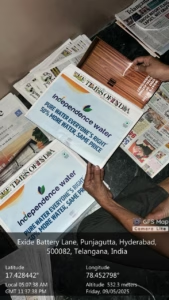
Paper Insertion Advertising serves a very specific role in the marketing ecosystem. Its primary function is not mass persuasion but trust activation at the local level.
It establishes credibility in familiar environments, generates fast awareness within defined pin codes, signals legitimacy for institutions, and reinforces offline brand presence where decisions are actually made.
It is not a replacement for digital or outdoor advertising. It works best as a trust amplifier that bridges awareness and action in markets where credibility matters more than novelty.
Key Features with Practical Context
High Trust Environment
Newspapers in India are still viewed as credible information sources rather than entertainment platforms. When a brand appears inside a newspaper, it inherits a layer of institutional trust by association.
For parents evaluating schools or colleges, this perceived legitimacy carries more weight than creative design or aggressive messaging.
Pin Code Level Targeting
Paper insertions can be distributed area wise, ward wise, or district wise. This allows brands to concentrate budgets exactly where admissions, inquiries, or walk ins are most likely to come from.
This precision significantly reduces wastage compared to broad reach mass media campaigns.
One Day Saturation Impact
Unlike digital campaigns that depend on repeated exposure over weeks, paper insertion can saturate a locality in a single morning. This immediacy is particularly effective during admission seasons, limited period offers, or new branch announcements.
Tangible Retention
Printed inserts often remain on dining tables, notice boards, or shelves. They are revisited, shared, and discussed among family members. This creates organic repetition without additional media spend.
Benefits for Businesses
Paper Insertion Advertising offers instant credibility without long brand building cycles. It delivers a lower cost per qualified household compared to many digital formats when targeting is done correctly.
It creates high recall among older decision makers who often influence or finalize decisions. It also supports offline to online conversion when combined with phone numbers, QR codes, or visit addresses.
Most importantly, it works well within short decision windows, especially in education, healthcare, and local service categories.
Paper insertion does not chase attention. It enters an environment where attention already exists.
Industries and Use Cases Where It Works Best
Paper Insertion Advertising consistently performs well in sectors where trust outweighs novelty.
This includes schools, colleges, and educational institutions, hospitals and diagnostic centers, real estate projects, retail showrooms, financial service branches, and community driven campaigns.
If your customer discusses the decision with family members before acting, this medium remains highly effective.
Where and When It Is Most Effective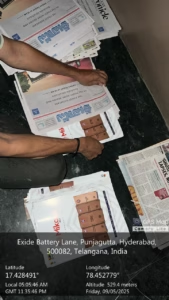
Geographically, paper insertion performs best in Tier 2 and Tier 3 cities, semi urban areas, and residential neighborhoods with family households.
Timing plays a critical role. Admission seasons, festival periods, salary cycles, and local event timelines significantly influence response rates.
Paper insertion is context sensitive. Proper timing often multiplies impact more than design creativity.
Customization and Creative Options
Execution quality determines outcomes. Effective paper insertion campaigns focus on language localization, simple hierarchy, and clarity over cleverness.
Communication should prioritize institution name, trust indicators, clear offers, and direct contact information. Designs must remain readable and official rather than promotional or decorative.
Paper quality, layout balance, and message clarity directly influence perceived seriousness and credibility.
Overdesign reduces trust. Simplicity converts better.
Why Choose Our Agency
At Raagnaai Ads, paper insertion is treated as a local trust deployment strategy, not just a printing or distribution task.
We manage newspaper selection based on verified circulation, area specific planning, creative structuring aligned with Indian reading behavior, print quality control, and timing based on real decision cycles.
Offline marketing fails not because the medium is weak, but because execution is careless. Our focus is precision, credibility, and accountability.
Getting Started
Paper Insertion Advertising continues to work because human behavior has not evolved as fast as marketing platforms.
In India, trust is still built offline, inside homes, through familiar daily habits. Newspapers remain one of those habits. When a brand enters that space thoughtfully, it stops feeling like an advertisement and starts feeling like a legitimate option.
For institutions and businesses that depend on reputation rather than hype, paper insertion remains a high leverage and underutilized channel.