The modern consumer is bombarded with advertisements everywhere—on phones, televisions, and social media. Yet, studies show that offline advertising continues to drive higher recall and trust compared to digital ads. For businesses targeting local audiences, traditional formats remain essential. One such powerful yet cost-effective method is Auto Top Branding—a strategy where brands use auto-rickshaws as moving billboards to reach thousands of people every single day.
According to industry reports, India has over 10 million auto-rickshaws operating in urban and semi-urban regions. In a city like Hyderabad alone, 2–3 lakh autos run daily, moving through main roads, residential colonies, offices, shopping complexes, and schools. This constant mobility makes auto tops one of the most visible, affordable, and high-frequency traditional marketing channels available today.
What is Auto Top Branding?
Auto Top Branding (also known as Auto Rickshaw Advertising or Auto Top Panels) involves placing advertisement boards on the roof section of auto-rickshaws. These panels typically measure 20–25 inches in height and span the length of the auto roof, making them highly visible to pedestrians, bikers, car passengers, and even bus commuters.
Unlike static hoardings placed at fixed points, autos travel 40–70 km per day, covering multiple routes. On average, one branded auto can generate 300–500 impressions per day, and when scaled across 100 autos, businesses can reach 30,000–50,000 people daily.
Purpose and Marketing Role
The core purpose of Auto Top Branding is to create repeated brand exposure at a fraction of the cost of billboards or digital campaigns. Its role in marketing can be summarized in three dimensions:
- Local Penetration – Helps brands become familiar in specific neighborhoods, colonies, or city areas where they want dominance.
- Mass Outreach – Since autos move continuously, a single campaign can cover markets, bus stops, metro stations, schools, and IT hubs.
- Trust & Familiarity – Psychological studies confirm that brands seen repeatedly in physical spaces build credibility faster.
Key Features of Auto Top Branding
- High Visibility at Eye Level – Positioned at a natural viewing angle for pedestrians, bikers, and commuters in cars.
- Wide Mobility Advantage – Unlike static billboards that cost lakhs, autos cover narrow lanes, residential colonies, and urban hotspots.
- Cost-Effective Model – Average cost is ₹400–₹800 per auto per month, making it accessible even for small businesses.
- Day-to-Day Exposure – A commuter who travels the same route daily may see your ad 10–15 times a week, strengthening recall.
- Localized Precision – Brands can choose targeted routes—near schools for education ads, near hospitals for healthcare brands, or near malls for retail.
Benefits for Businesses
- Affordable Advertising for All Sizes – From startups to multinational companies, auto branding fits all budgets.
- Boosts Store/Clinic Footfall – Works especially well for hospitals, restaurants, retail showrooms, and tuition centers.
- Enhances Trust – Local people feel the brand is “part of their city,” creating stronger emotional connections.
- 24/7 Promotion – Unlike digital ads with limited time slots, auto branding runs all day, every day.
- Works in Combination – When paired with hoardings or radio ads, impact is multiplied.
Industries & Use Cases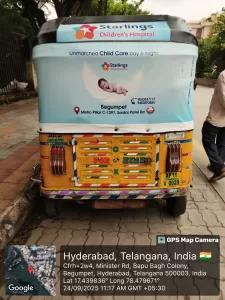
Auto Top Branding is a multi-industry solution, and what makes it powerful is its adaptability. Different industries can use it in different ways, and the success lies in how well the execution matches the customer base. Let’s break this down industry by industry with data-driven insights:
1. Hospitals & Clinics
- Why it works: Healthcare is built on trust and visibility. Parents, senior citizens, and families are more likely to trust hospitals they see advertised repeatedly in their own neighborhoods.
- Reach: In a city like Hyderabad with over 30 lakh daily commuters, even a fleet of 200 branded autos can reach lakhs of families within 30 days.
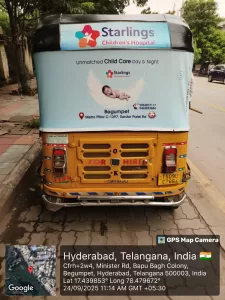
- Use Case: Raagnaai Ads promoted Starling Children’s Hospital via autos running around schools, residential colonies, and pediatric clinics. This ensured direct visibility among parents, the hospital’s target audience.
2. Retail Stores & Supermarkets
- Why it works: Retail depends on footfall and local dominance. A store must be top-of-mind for nearby shoppers.
- Example: A supermarket in Kukatpally could use 100 autos covering 5 km radius routes to reach daily wage workers, homemakers, and office goers.
- Impact: Studies show 70% of retail customers visit stores within 5–6 km of their homes. Auto branding directly covers this radius.
3. Restaurants & Food Chains
- Why it works: Food businesses thrive on impulse and repetition. When people see a restaurant ad daily, they are more likely to try it on weekends or evenings.
- Example: Domino’s and KFC often run short-term auto campaigns near IT parks and student areas.
- Data Point: Quick Service Restaurants (QSRs) using localized outdoor ads see a 20–25% increase in weekend orders.
4. Education Institutes
- Why it works: Students and parents are highly location-based. Schools, coaching centers, and colleges need to be visible around student-heavy areas.
- Example: A coaching center in Dilsukhnagar could brand 50–70 autos near metro stations, bus stops, and junior colleges.
- Impact: Outdoor campaigns for education institutes contribute to 30–35% of new admissions, as per ASSOCHAM reports.
5. Banks & Financial Services
- Why it works: Loans, insurance, and branch openings need trust + frequency. Auto branding builds visibility near commercial hubs and markets.
- Example: A new bank branch in LB Nagar can use autos to cover local bazaars, ensuring small business owners notice.
- Data Point: 42% of small business owners in Tier 1 & 2 cities trust financial brands they repeatedly see in offline spaces.
6. FMCG & Consumer Goods
- Why it works: FMCG relies on mass adoption and recall value. Autos, with their daily 40–60 km travel, cover every section of society.
- Example: Soap or soft drink companies can brand 500 autos city-wide, creating mass familiarity in weeks.
- Impact: FMCG companies spend nearly 12–15% of their offline budgets on moving ads (autos, vans) because of their unmatched reach.
Where & When Auto Branding is Most Effective
1. Festive Seasons
- Dussehra, Diwali, Sankranti, and Ugadi are peak shopping and spending periods.
- Data Point: During festivals, average household spending increases by 30–40%, and recall of offline ads jumps by 45% (Indian Outdoor Advertising Report, 2024).
- Auto branding during this period helps businesses get maximum attention at minimum cost.
2. Product Launches
- Perfect for creating city wide buzz within weeks.
- Example: A new mobile phone brand can brand 500 autos for 30 days, ensuring lakhs of impressions before launch.
3. Local Business Expansions
- A restaurant opening its second branch in Hyderabad can use autos to tell locals “Now Open at Jubilee Hills.”
- Localized auto branding ensures the message is visible exactly where it matters.
Customization & Creative Options
Brands can make auto branding unique and engaging by adding creative elements:
- Design Choices:
- Use bright brand colors (red for food, green for organic, blue for hospitals).
- Use large fonts for visibility in traffic.
- Add catchy taglines like “Hyderabad ki Apni Hospital” for Starling.
- QR Codes & Digital Connectors:
- QR codes leading to store location, offers, or WhatsApp chat.
- Example: A restaurant could add “Scan for 10% off today.”
- Language Personalization:
- Using Telugu for AP & Telangana ensures emotional connection.
- Data shows ads in local languages perform 28% better in recall.
- Rotational Campaigns:
- Different messages on different autos (e.g., one promoting OPD hours, another promoting emergency care for a hospital).
- Festive Thematics:
- Adding festive colors or greetings during Diwali/Sankranti builds community connect.
Why Choose Raagnaai Ads
Many businesses fail with auto branding because of poor execution. They may put ads on random autos without tracking routes or ensuring quality printing. Raagnaai Ads solves this with professional campaign management:
- Route Mapping: We identify high-traffic routes near your target audience (schools, IT parks, malls).
- Daily Monitoring: Regular updates with photos/videos of autos on roads.
- Creative Support: Our design team ensures your ad is eye-catching and professional.
- Scalable Execution: Whether you need 10 autos for a colony-level campaign or 500 autos for city-wide dominance.