Most brands fail for one simple reason: people don’t remember them.
Not because the product is bad. Not because pricing is wrong. But because the brand is invisible where it actually matters — on the streets, in daily life, in real customer environments.
Digital marketing has created a false sense of visibility. You get impressions, clicks, maybe even leads. But in Tier 2 and Tier 3 markets like Andhra Pradesh and Telangana, real buying decisions are still driven by physical visibility and repeated exposure.
If your brand is not seen regularly in public spaces, it does not exist in the customer’s mind.
That’s where Canter Van Advertising becomes a high-leverage tool — not as a gimmick, but as a controlled, mobile visibility system.
What is Canter Van Advertising
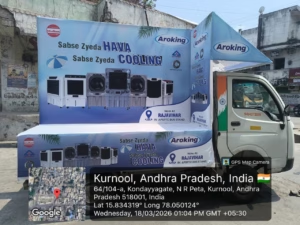
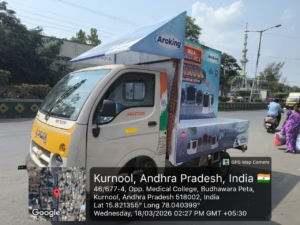
Canter Van Advertising is a mobile outdoor advertising format where a branded vehicle moves across targeted locations while broadcasting your brand message through:
-
High-visibility vinyl branding
-
Audio announcements (jingles, offers, brand messaging)
-
On-ground engagement (optional)
Unlike static hoardings, this is movement-based advertising, which means your brand doesn’t wait for attention — it goes and captures it.
A typical setup includes:
-
Fully wrapped canter van with brand creatives
-
Loudspeaker system for audio communication
-
Planned route covering high-footfall areas
-
Optional promoters for direct interaction
This is not just advertising. It’s active brand penetration.
Purpose and Marketing Role
Most businesses misunderstand this.
Canter Van Advertising is not for immediate conversions. It is for:
1. Creating First-Level Awareness
People need to see your brand multiple times before trusting it. This creates familiarity.
2. Building Recall Through Repetition
When a van passes through the same locality multiple times, the brand gets embedded in memory.
3. Hyperlocal Domination
Instead of wasting budget on wide but weak reach, you dominate specific areas where your customers actually live.
4. Bridging Offline Attention Gap
Digital ads are ignored. Street-level advertising is not.
If used correctly, this becomes a foundation layer of your marketing system.
Key Features (With Real Execution Context)
1. Mobile Visibility Across Locations
Instead of one location, you cover:
-
Residential areas
-
Market streets
-
Traffic junctions
-
Events and melas
This increases exposure density without increasing infrastructure cost.
2. Audio Messaging (Underrated but Powerful)
Most brands ignore audio. That’s a mistake.
A well-crafted local-language jingle:
-
Cuts through noise instantly
-
Feels familiar and relatable
-
Drives faster recall than visuals alone
Example: A cooling product brand announcing offers during summer in busy streets. That timing + context = effectiveness.
3. Route Planning (Where Most Campaigns Fail)
Execution decides results.
Random driving = wasted budget.
Professional campaigns:
-
Map high-density customer areas
-
Target peak hours (morning/evening)
-
Repeat routes for reinforcement
Without this, results drop sharply.
4. Cost Efficiency vs Static Media
A hoarding sits in one place.
A canter van:
-
Covers 10–20 locations daily
-
Reaches multiple audience clusters
-
Generates repeated impressions
This is better cost per recall, not just cost per impression.
Benefits for Businesses
1. Strong Local Brand Recall
People start recognizing your brand name, colors, and message without effort.
2. Faster Market Penetration
New brands entering a location can quickly establish presence.
3. Budget Control
You don’t need massive budgets. You can scale based on:
-
Days
-
Locations
-
Campaign intensity
4. Real-World Trust Building
People trust brands they see physically more than digital-only brands.
5. Complements Digital Campaigns
When customers see your ad online + hear your brand offline, conversion probability increases significantly.
Industries / Use Cases Where It Works Best
This is not universal. It works best where:
High Local Dependency Exists
-
Retail stores
-
Supermarkets
-
Electronics shops
-
Furniture brands
Seasonal Demand is Strong
-
Air coolers / ACs (summer)
-
Schools / colleges (admissions season)
-
Festivals / offers
Mass Audience Targeting is Needed
-
FMCG products
-
Healthcare camps
-
Political campaigns
-
Real estate launches
If your audience is location-bound, this works. If your business is purely online SaaS — this is irrelevant.
Where & When It Is Most Effective
Where
-
Tier 2 & Tier 3 cities
-
Dense residential clusters
-
Weekly markets / bazaars
-
Event zones
When
-
Morning (7–10 AM): decision-making time
-
Evening (5–9 PM): high footfall
-
Seasonal peaks: summer, festivals
Timing is not optional. It directly impacts ROI.
Customization & Creative Options
Most campaigns fail because they look generic.
Effective campaigns focus on:
1. Clear, Bold Messaging
People have 3–5 seconds to notice. Avoid clutter.
2. Local Language Communication
English doesn’t convert in local streets. Regional language wins.
3. Strong Audio Hooks
Repetitive, simple, catchy messaging.
4. Offer-Based Communication
“Visit Today”, “Limited Offer”, “Near You” — these trigger action.
5. Visual Dominance
Large fonts, high contrast colors, minimal text.
Creativity here is not about design awards. It’s about attention capture and recall.
Why Choose Raagnaai Ads
Most agencies just provide vehicles. That’s not enough.
Execution quality determines whether this becomes:
-
A visibility asset
OR -
A moving waste of budget
Raagnaai Ads focuses on:
-
Strategic route planning based on audience density
-
Professionally designed branding creatives
-
High-quality audio messaging in local language
-
Ground-level execution with consistency
-
Budget optimization without cutting impact
This is not just service delivery. It’s campaign control.
Getting Started
If your brand is not visible, it is not remembered. If it is not remembered, it is not chosen.
Canter Van Advertising is not a fancy marketing tactic. It is a practical, proven method to build local dominance — especially in markets where digital alone cannot create trust.
Used correctly, it:
-
Increases recall
-
Strengthens presence
-
Supports conversions
Used poorly, it becomes noise.
The difference is execution.