Most brands don’t fail because of poor products; they fail because people never experience them. This is the uncomfortable truth most marketers ignore. Digital campaigns create visibility, but visibility without interaction rarely converts into sales. Billboards give reach, but they don’t build trust. Social media generates engagement metrics, but not necessarily buying intent. The real gap is simple—there is no direct connection between the brand and the customer.
In markets like Andhra Pradesh and Telangana, where purchase decisions are still influenced heavily by physical validation, this gap becomes even more critical. People want to see, touch, test, and understand before they commit. If that step is missing, they delay or ignore the purchase altogether. Demo Table Advertising directly addresses this failure point by taking the brand into the public space and turning passive attention into active interaction.
What is Demo Table Advertising
Demo Table Advertising is a ground-level brand activation method where a portable, branded table is set up in high-footfall locations to demonstrate products, distribute samples, and interact directly with potential customers. The key advantage is not just visibility, but execution speed and flexibility. Within minutes, a setup can be operational in places like busy streets, markets, malls, college campuses, or residential areas.
Unlike traditional advertising formats that rely on passive consumption, this approach is active. The brand doesn’t wait to be noticed—it initiates engagement. Customers can ask questions, see the product in action, and form opinions immediately. This is where actual buying decisions begin, not in front of a screen but in real-world interaction.
Purpose and Marketing Role

The primary purpose of Demo Table Advertising is to convert attention into meaningful engagement. Most marketing efforts stop at awareness, but awareness alone doesn’t drive revenue. This method pushes the customer one step further into the decision-making process by creating interaction.
It also builds instant trust. When customers physically experience a product, skepticism reduces significantly. This is especially important for new brands or products entering competitive markets. In addition, it reduces purchase friction. When doubts are addressed in real time through demonstration and conversation, the resistance to buying drops.
Another critical role it plays is enabling a direct feedback loop. Unlike digital campaigns where feedback is delayed or filtered, here you get immediate, unfiltered responses. You understand objections, preferences, and buying signals directly from the market. This is not theoretical data—it is real behavioral insight.
Key Features of Demo Table Advertising
One of the strongest features is its quick setup capability. Within five minutes, a demo table can be installed and operational without complex infrastructure or heavy logistics. This allows brands to execute campaigns rapidly and efficiently.
Mobility is another major advantage. If a location is underperforming, the setup can be shifted immediately. This eliminates one of the biggest inefficiencies in traditional advertising—spending money on locations that don’t deliver results.
Direct customer interaction is the core strength. Promoters can explain product benefits, demonstrate usage, handle objections, and offer samples in real time. This depth of engagement is something digital formats cannot replicate.
Another important feature is the combination of visibility and experience. The brand is not just seen; it is experienced. This significantly improves recall and increases the likelihood of conversion. Despite its effectiveness, the cost structure remains relatively low compared to large-scale advertising formats, making it a high-impact, cost-efficient strategy.
Benefits for Businesses
The most immediate benefit is direct lead generation. Instead of waiting for customers to respond to ads, brands can generate inquiries, interactions, and even sales on the spot. This shortens the conversion cycle significantly.
It also enables faster market penetration. When entering a new area, building awareness through traditional methods takes time. Demo Table Advertising accelerates this by creating instant visibility and interaction in targeted locations.
Another key advantage is stronger local brand recall. People remember experiences far more than visuals. A customer who interacts with a product is more likely to recall and recommend it compared to someone who only saw an advertisement.
From a return-on-investment perspective, this method performs better than passive advertising. While the reach may be lower, the engagement and conversion rates are significantly higher. Additionally, it allows real-time strategy adjustments. Messaging, positioning, and approach can be refined instantly based on customer reactions.
Industries and Use Cases Where It Works Best
Demo Table Advertising works best in industries where customer experience directly influences buying decisions. This includes FMCG products, where sampling can drive immediate trials; consumer electronics, where demonstration clarifies value; and personal care products, where trust and experience are critical.
It is also highly effective in healthcare awareness campaigns, educational promotions, and retail product launches. In each of these cases, the ability to explain, demonstrate, and interact directly with the audience creates a measurable impact.
From a situational perspective, it performs well during product launches, market entry campaigns, festival promotions, seasonal sales, and awareness drives. Any scenario where the product requires explanation or trust-building is suitable for this approach.
Where and When it is Most Effective
Effectiveness depends heavily on execution. High-footfall locations such as busy streets, markets, shopping areas, and transit points provide the best results. Colleges and event spaces also offer strong engagement opportunities depending on the target audience.
Timing is equally critical. Evenings, weekends, and festival periods typically generate higher interaction due to increased public movement. Poor timing can significantly reduce effectiveness, regardless of the quality of setup or product.
Customization and Creative Options
Demo Table Advertising is highly adaptable. Branding elements such as custom-designed tables, backdrops, standees, and product displays can be tailored to align with the brand identity. This ensures consistency and professionalism in presentation.
Engagement strategies can also be customized. Live demonstrations, free samples, interactive activities, and digital integrations like QR codes for lead capture can be incorporated to enhance effectiveness.
However, the most critical factor is the promoter. Execution quality depends on communication skills, product knowledge, and the ability to persuade. A poorly trained promoter can undermine the entire campaign, while a skilled one can significantly increase conversions.
Why Choose Raagnaai Ads
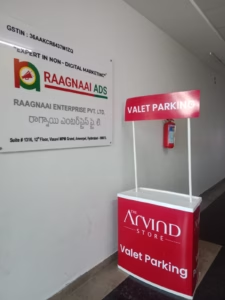
Most agencies approach demo table campaigns as routine execution tasks. That approach fails because the outcome depends on strategy, not just setup. Location selection, promoter quality, and execution discipline determine results.
Raagnaai Ads focuses on strategic placement based on real footfall patterns, not assumptions. Promoters are trained to communicate value, not just distribute samples. Branding is customized to ensure visibility and consistency. On-ground supervision ensures that execution meets performance expectations.
The difference is straightforward. Many agencies execute activities. Raagnaai Ads focuses on executing outcomes.
Getting Started
Demo Table Advertising remains one of the most underutilized yet effective tools in traditional marketing. Its strength lies in aligning with real customer behavior. People trust what they experience, they buy what they understand, and they remember what they interact with.
If marketing efforts are limited to visibility without interaction, conversion potential is lost. This method directly addresses that gap by bringing the brand into the customer’s environment and creating immediate engagement.