Introduction
Modern marketing has a visibility problem. Brands are seen everywhere social feeds, billboards, YouTube ads—but purchase hesitation remains high. Why? Because exposure does not equal belief.
Customers do not commit money based on impressions. They commit after clarity, confidence, and experience.
If your product needs explanation, demonstration, or credibility building digital awareness alone is insufficient. You need structured physical interaction. This is where Demo Tent Advertising becomes operationally powerful.
For marketing managers and brand heads who care about measurable impact, demo tents are not decorative setups. They are controlled customer-conversion environments designed for direct engagement.
What is Demo Tent Advertising?
Demo Tent Advertising is a structured offline activation model where a fully branded, strategically installed tent serves as a temporary experiential marketing unit. It allows brands to interact directly with customers in high-footfall areas.
This format combines branding, product education, live demonstration, and lead generation into one physical setup.
A professionally executed demo tent includes:
-
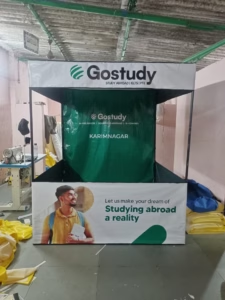
Custom-branded canopy and walls
-
Product display counters
-
Trained brand representatives
-
Live demonstrations or service walkthroughs
-
Sampling or hands-on trial opportunities
-
Data collection and feedback capture
It is not a passive display tool. It is an engagement-driven marketing mechanism.
Unlike static outdoor media, demo tents create two-way communication. That difference is what drives conversion.
The Marketing Purpose Behind Demo Tent Advertising
1. Education-Based Selling
Many products fail in the market not because they lack quality, but because customers do not fully understand them. This is common in:
-
Financial services
-
EdTech programs
-
Health supplements
-
Smart electronics
-
Subscription-based services
When customers can ask direct questions and receive clear answers, friction reduces immediately. Education shortens the buying cycle.
2. Trust Building Through Physical Presence
Research consistently shows that physical brand presence increases perceived legitimacy. When a brand invests in on-ground activation, it signals seriousness and long-term intent.
A demo tent installed in a residential or commercial area sends a powerful psychological message:
“We are present. We are accessible. We are accountable.”
That perception builds trust faster than digital impressions ever can.
3. Experience-Driven Conversion
Trial eliminates doubt.
When customers physically experience a product—taste it, test it, try it, interact with it—their resistance drops. Demonstration reduces uncertainty, and uncertainty is the biggest barrier to purchase.
Demo tents are designed to convert curiosity into commitment.
Core Features of Effective Demo Tent Advertising
Strategic Location Planning
Success is not about putting a tent anywhere. It is about placing it where your ideal customers already are.
Effective placements include:
-
Residential communities
-
Shopping complexes
-
Weekly markets
-
Corporate parks
-
Exhibition grounds
-
Festival zones
Location defines audience quality. Poor placement destroys ROI.
Structured Demonstration Process
A demo tent without structured presentation is wasted budget.
Professional execution includes:
-
Clear product explanation flow
-
Problem-solution framing
-
Visual support materials
-
Real-time product usage
-
Controlled customer interaction
For example, a kitchen appliance brand should not just display the product—it should cook live. A fintech company should onboard users instantly. A skincare brand should conduct live application demos.
Demonstration must create tangible value in minutes.
Data Capture and Lead Collection
Modern Demo Tent Advertising integrates offline and digital.
This includes:
-
QR code scans
-
Instant discount coupons
-
WhatsApp opt-ins
-
Digital forms
-
CRM-linked lead tracking
If you are not capturing data, you are losing half the value of activation.
Offline engagement + digital nurturing = sustainable marketing funnel.
Brand Customization and Visual Impact
Professional demo tents are customized with:
-
Full canopy printing
-
Side storytelling panels
-
LED lighting for evening visibility
-
Product benefit graphics
-
Branded uniforms for promoters
-
Interactive displays
Visual differentiation matters. In crowded markets, generic setups are ignored.
Business Benefits of Demo Tent Advertising
Faster Market Penetration
For new product launches or new regional entries, demo tents accelerate local awareness. Instead of waiting for gradual brand buildup, you create immediate visibility and engagement.
In emerging markets, physical presence often builds credibility faster than digital advertising.
Improved Conversion Quality
Leads generated from face-to-face interactions are typically higher quality. Customers who engage physically show stronger purchase intent compared to passive ad viewers.
This improves sales team efficiency.
Real-Time Market Feedback
Brands gain valuable insights:
-
Which features attract attention
-
What objections customers raise
-
How pricing is perceived
-
What competitors are being mentioned
This data is raw and unfiltered. It is more actionable than many formal surveys.
Budget Flexibility
Compared to large-scale events, Demo Tent Advertising offers scalability.
You can:
-
Deploy in one location
-
Scale to multiple neighborhoods
-
Run weekend campaigns
-
Execute seasonal drives
Budget allocation remains controlled and adaptable.
Industries Where Demo Tent Advertising Performs Strongly
Demo Tent Advertising is especially effective in industries where explanation and trust drive sales.
High-performance sectors include:
-
FMCG and packaged goods
-
Consumer electronics
-
Real estate previews
-
Banking and insurance
-
EdTech and training institutes
-
Healthcare and diagnostics
-
Fitness and wellness brands
-
Retail store launches
If the product benefits from physical interaction, demo tents increase impact.
When Demo Tent Advertising Delivers Maximum Results
The format performs best during:
-
Product launches
-
Festive promotions
-
Anniversary sales
-
New store openings
-
Regional market expansion
-
Awareness campaigns
Timing matters. Activation must align with sales objectives.
Running demo tents without a clear campaign goal reduces effectiveness.
Customization & Creative Strategy Options
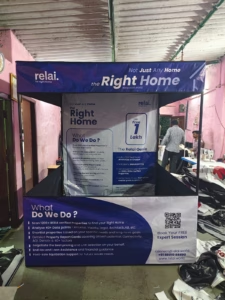
To maximize ROI, demo tents should be creatively differentiated.
Options include:
-
Theme-based installations
-
Limited-time offer branding
-
Live product competitions
-
Sampling drives
-
Gamified customer engagement
-
On-spot registration incentives
-
Co-branded partnerships
Creative execution determines crowd attraction. Structure determines conversion.
Why Execution Quality Determines Success
Many demo tent campaigns fail due to poor management.
Common mistakes include:
-
Untrained promoters
-
Weak messaging
-
No data collection system
-
Wrong location selection
-
No follow-up process
Professional traditional marketing agencies handle:
-
Location research
-
Permission management
-
Creative design
-
Logistics coordination
-
Promoter training
-
Performance tracking
Without structured execution, demo tents become visual clutter.
With proper execution, they become revenue drivers.
Conclusion
Demo Tent Advertising is not about setting up a temporary structure. It is about creating a controlled environment where your brand interacts directly with its target audience.
In markets where customer trust, product clarity, and physical experience influence buying decisions, this format remains one of the best offline advertising methods available.
Brands that depend only on passive awareness tools limit their conversion potential. Brands that combine awareness with structured engagement outperform.