Most brands invest heavily to bring customers to their store. They run digital campaigns, outdoor ads, influencer promotions, and performance marketing funnels. All of that effort has one goal: get attention and drive footfall.
But here is where most businesses fail.
The moment a customer walks into the store, the marketing stops.
There is no structured experience. No controlled messaging. No reinforcement of brand positioning. What happens inside the store is often left to chance, staff behavior, or basic product display.
This is a critical mistake.
Because in reality, the highest intent customer interaction happens inside the store. This is where perception is formed, trust is built, and decisions are made.
In Store Branding Advertising exists to solve exactly this gap. It ensures that the same level of strategic effort used to bring customers in is applied to influence them when they are most ready to act.
What is In Store Branding Advertising
In Store Branding Advertising is a structured approach to designing and controlling the customer experience inside a physical retail space using visual communication, layout psychology, and brand storytelling.
It is not decoration.
It is not random posters.
It is not just “making the store look good.”
It is a deliberate system where every visual element inside the store communicates something specific about the brand.
This includes:
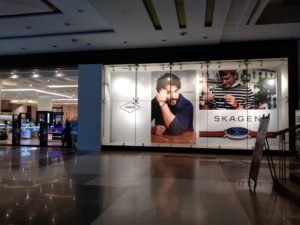
Wall graphics that communicate brand values
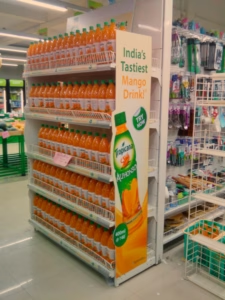
Shelf branding that guides product perception
Signage that influences decision making
Display units that control attention flow
Visual storytelling that builds trust
The goal is simple: convert footfall into memory, and memory into preference.
Purpose and Marketing Role
The role of In Store Branding Advertising is often misunderstood.
Most businesses think marketing ends when a customer enters the store. In reality, that is where the most important part begins.
At that stage, the customer is:
Already aware of your brand
Already interested enough to visit
Already comparing options in their mind
This is where psychology matters more than reach.
In Store Branding plays three critical roles:
First, it reinforces brand identity. Customers should immediately understand what your brand stands for without asking.
Second, it reduces decision friction. Clear messaging and structured visuals help customers make faster and more confident decisions.
Third, it creates emotional connection. A well designed store does not just sell products. It creates a feeling. That feeling becomes recall.
Without this layer, brands lose control over how they are perceived at the most important touchpoint.
Key Features Explained Clearly
A strong In Store Branding system is built using multiple elements working together, not in isolation.
Visual hierarchy is the foundation. Customers do not scan every detail. They notice what stands out first. Strategic placement of bold visuals, colors, and messaging ensures attention flows in a controlled direction.
Zoning is another critical feature. The store is divided into areas based on purpose. Entry zone builds impression. Mid zone drives engagement. Conversion zone pushes decision making. Without zoning, stores become cluttered and confusing.
Brand consistency ensures every touchpoint looks and feels aligned. Fonts, colors, tone, and messaging must match across all elements. Inconsistent stores feel unprofessional and reduce trust instantly.
Point of purchase communication directly influences buying decisions. Shelf talkers, product highlights, and benefit driven messaging work here. This is where most conversions are won or lost.
Experience layering adds depth. This includes lighting, textures, layout spacing, and even movement patterns. Customers should feel guided, not lost.
Each of these features is practical, measurable, and directly tied to customer behavior.
Benefits for Businesses
The biggest advantage of In Store Branding is that it operates where intent is already high.
This means results are not dependent on reach but on influence.
The first benefit is higher conversion rates. When customers clearly understand product value and brand positioning, decision making becomes easier.
The second benefit is stronger brand recall. People remember experiences, not just products. A well designed store stays in memory longer than a digital ad.
The third benefit is premium perception. Even average products can feel high value when presented correctly. Poor presentation does the opposite.
The fourth benefit is reduced dependency on discounts. When perception improves, price sensitivity reduces. Brands stop competing only on cost.
The fifth benefit is word of mouth amplification. Customers are more likely to talk about spaces that feel different and well designed.
These are not theoretical advantages. They are direct outcomes of controlled customer experience.
Industries and Use Cases Where It Works Best
In Store Branding is not limited to large retail chains. It works across multiple industries where physical interaction plays a role.
Retail stores benefit the most because product visibility and comparison happen on the spot.
Jewelry stores rely heavily on trust and premium perception. Store experience directly influences buying confidence.
Electronics showrooms need structured communication to explain features and justify pricing.
Pharmacies and wellness stores use clear categorization and guidance to simplify customer decisions.
Restaurants and cafes use branding to create atmosphere and identity, which affects repeat visits.
Even service based businesses like salons, clinics, and experience centers benefit from strong in store branding because perception drives trust.
Any business where customers physically enter a space has an opportunity to influence behavior through branding.
Where and When It is Most Effective
In Store Branding is most effective in environments with moderate to high footfall.
If customers are already visiting, even small improvements in experience can lead to significant gains in conversion and recall.
It becomes critical when:
A new store is launched and first impressions matter
A brand is repositioning and needs to communicate a new identity
Competition is high and differentiation is required
Customers are confused between multiple product options
The brand wants to move from price based selling to value based selling
Timing also matters.
Festive seasons, product launches, and promotional cycles are high impact periods where in store branding can amplify results significantly.
Ignoring this layer during peak traffic periods is a direct loss of potential revenue.
Customization and Creative Options
There is no one size fits all model in In Store Branding.
Everything must be tailored based on brand identity, target audience, and store layout.
Customization happens at multiple levels.
Material selection changes based on durability, budget, and visual impact. Options range from vinyl graphics to premium acrylic installations.
Design language is adapted based on brand positioning. A premium brand uses minimal and clean visuals, while a mass brand may use bold and high visibility elements.
Messaging strategy varies depending on product complexity. Simple products need quick benefits, complex products need guided explanations.
Layout adjustments depend on store size and customer movement patterns.
Creative elements can include thematic installations, storytelling walls, product highlight zones, and interactive displays.
The key is not creativity for the sake of it, but creativity that supports business goals.
Why Choose Our Agency
Most agencies treat in store branding as a design task. That is where they fail.
Execution without strategy leads to good looking stores that do not perform.
Our approach is different.
We start with understanding customer behavior inside the store. Where they stop, where they hesitate, where they decide.
We design based on psychology, not assumptions.
Every element we create has a purpose. Every placement has a reason. Every message is aligned with business goals.
We do not overload stores with visuals. We remove noise and create clarity.
We focus on what actually drives results: attention, understanding, and decision making.
Our work is built to influence behavior, not just improve aesthetics.
Getting Started
Bringing customers to your store is only half the job.
What happens inside determines whether that effort converts into revenue or gets wasted.
In Store Branding Advertising is not optional anymore. It is a core layer of modern marketing that directly impacts how customers perceive, trust, and choose your brand.
Ignoring it means leaving money on the table.
Investing in it means controlling the most critical part of the customer journey.