Introduction
Most brands fail at one critical point not because they lack budget but because they fail to capture attention in the real world. Digital ads are ignored, skipped, or blocked. Static outdoor ads like hoardings are seen but rarely remembered. The core problem is simple people notice movement, human presence, and interaction far more than passive displays. If your brand is not breaking that pattern, it is invisible.
This is where Look Walker Advertising becomes relevant. It operates on a basic but powerful human behavior principle people react to other people. When a brand message is carried by a person moving through crowded areas, it interrupts routine, creates curiosity, and forces attention. That attention, if executed correctly, converts into recall and sometimes direct action.
What is Look Walker Advertising
Look Walker Advertising is a ground level outdoor marketing method where trained promoters walk through high footfall areas carrying branded displays such as LED boards, posters, digital screens, or creative wearable branding units. Instead of waiting for the audience to pass by an ad, the advertisement actively moves through the audience.
This is not just about visibility. It is about proximity and presence. The brand is no longer a distant billboard. It is physically entering the consumer’s personal space in a controlled and strategic way. This makes it significantly harder to ignore compared to static advertising formats.
The real power of this method lies in combining visual display with human interaction. A walker can engage, explain, distribute flyers, or even demonstrate a product. This converts passive exposure into active engagement.
Purpose and Marketing Role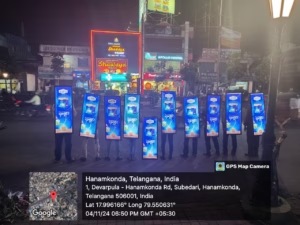
The purpose of Look Walker Advertising is not just awareness. It is controlled attention capture in environments where distraction is high. Traditional outdoor advertising depends on location. This depends on movement and interaction.
In the marketing funnel, this strategy sits between awareness and activation. It does not just show your brand. It creates a micro experience around it. This is especially useful when a brand needs quick recall in a local market or wants to create buzz within a short time frame.
From a strategic perspective, this method solves three major issues. First, ad blindness people ignoring static ads. Second, limited engagement passive formats. Third, location dependency fixed ads rely heavily on the right spot. Look Walker Advertising bypasses all three by being mobile, interactive, and attention driven.
Key Features Explained with Practical Context
The first feature is mobility. Unlike billboards or kiosks, Look Walkers can move across multiple high traffic zones within a single day. This means one campaign can cover markets, malls, traffic junctions, events, and residential clusters without additional infrastructure cost.
The second feature is human engagement. A static ad cannot answer questions or react. A Look Walker can adapt messaging based on audience response. If people show interest, the interaction deepens. If not, the walker moves on. This flexibility increases efficiency.
The third feature is rapid deployment. Setting up large scale outdoor advertising takes time, permissions, and cost. Look Walker campaigns can be deployed within hours. This makes them highly effective for time sensitive promotions such as offers, openings, or event marketing.
The fourth feature is visibility in motion. Movement naturally draws attention. This is a psychological trigger. Humans are wired to notice moving objects more than static ones. A walking advertisement leverages this instinct.
The fifth feature is customizable messaging. From LED screens to printed boards to wearable displays, the format can be adapted based on campaign goals. This allows creative execution without being restricted by standard ad formats.
Benefits for Businesses
The biggest benefit is attention efficiency. You are not paying for space. You are paying for actual visibility and interaction. This reduces wastage which is common in traditional outdoor advertising.
Another key benefit is hyper local targeting. You can choose exactly where your brand appears. If your audience is in a specific market area, you place walkers there. If it is near colleges, offices, or events, you adjust accordingly. This level of control is rarely possible with fixed ads.
Cost effectiveness is another major advantage. Compared to large hoardings or digital screens, Look Walker campaigns require lower investment while delivering higher engagement per impression.
There is also a brand perception benefit. When people see a brand actively reaching out instead of passively advertising, it creates a sense of effort and presence. This builds trust, especially for local or emerging brands.
Finally, it enables immediate action. If combined with offers, QR codes, or samples, the conversion can happen on the spot. This shortens the customer journey significantly.
Industries and Use Cases Where It Works Best
Retail businesses benefit the most especially those relying on walk in customers. Clothing stores, electronics shops, supermarkets, and local outlets can use this to drive immediate footfall.
Real estate campaigns use it effectively during project launches to create local awareness and guide potential buyers to site locations.
Food and beverage brands use Look Walkers for product sampling and awareness especially in crowded areas like markets and college zones.
Event promotions such as exhibitions, concerts, or local events rely on this method for last mile reach and crowd pulling.
Service based businesses like gyms, salons, and coaching centers use it to target nearby audiences where conversion probability is high.
Where and When It is Most Effective
This method works best in high density, high movement environments. Markets, commercial streets, malls, traffic signals, and event venues are ideal.
Timing matters more than most people realize. Morning office hours, evening rush, weekends, and festival periods generate maximum impact. Running a campaign during low footfall hours is wasted effort.
It is also highly effective during launches, limited time offers, and seasonal campaigns where urgency needs to be created quickly.
The mistake most brands make is treating this like a random activity. Without proper route planning, timing, and messaging, the impact drops sharply. Execution discipline is what separates effective campaigns from wasted effort.
Customization and Creative Options
Look Walker Advertising is only as powerful as its execution. Basic boards will get attention. Creative formats will get remembered.
LED displays can be used for dynamic content. Motion graphics naturally attract more attention than static images.
Costume based branding can be used for higher recall especially in crowded environments. A well designed visual identity makes the campaign stand out instantly.
Interactive elements such as QR codes, discount coupons, or live demonstrations increase engagement depth. This converts curiosity into action.
Audio integration can be used in controlled environments but must be handled carefully to avoid becoming noise rather than attraction.
The key is not to overcomplicate. Most brands fail by trying to say too much. The message should be simple, visible, and immediately understandable within a few seconds.
Why Choose Our Agency
Execution is where most campaigns fail. Not in idea, not in budget, but in ground level execution. Poorly trained walkers, wrong locations, weak messaging, and lack of supervision kill results.
A professional agency brings structure. Route planning based on footfall data, trained promoters who understand engagement, quality display materials, and real time monitoring ensure that the campaign actually delivers.
Consistency is another factor. One day of activity does not build recall. Sustained presence does. Managing that requires coordination, logistics, and discipline which most brands cannot handle internally.
An experienced agency also understands local behavior. What works in one area may fail in another. Adapting messaging and approach based on location is critical.
Conclusion
Look Walker Advertising works because it aligns with how people actually behave in the real world. They notice movement, they respond to human presence, and they engage when approached correctly. Unlike passive advertising formats, this method actively inserts your brand into the audience’s environment.
However, it is not a magic solution. Poor execution will fail just as badly as any other marketing method. Success depends on clarity of message, quality of promoters, strategic location selection, and consistent execution.
When done correctly, it becomes one of the most efficient ways to generate attention, engagement, and local brand recall.