Most brands obsess over digital metrics such as clicks, impressions, and reach, yet ignore the most predictable source of attention: daily physical movement. Every metro commuter represents repeated exposure opportunity. When your brand is absent from that environment, you are not just missing visibility; you are surrendering daily lakhs of impressions to competitors.
Metro Pillar Advertising is not just outdoor media placement. It is structured repetition marketing. It works because urban audiences follow fixed travel routes. When a commuter sees your brand 20 to 40 times a month on the same route, brand recall compounds. Recognition turns into familiarity. Familiarity builds trust. Trust influences purchase.
For marketing managers, business owners, and brand heads operating in dense cities, ignoring metro infrastructure is a strategic blind spot.
What is Metro Pillar Advertising?
Metro Pillar Advertising refers to branding installed on structural pillars that support elevated metro corridors. These pillars are positioned along high traffic roads, commercial hubs, business districts, and residential catchments.
Unlike traditional hoardings that rely on wide but momentary visibility, metro pillars create linear repetition. A commuter driving alongside a metro corridor may pass 50 to 200 pillars in a single journey. When multiple consecutive pillars carry the same brand message, the psychological effect multiplies.
This is not random exposure. It is engineered frequency.
Purpose and Marketing Role
Metro Pillar Advertising serves three strategic roles.
1. Repetition Based Brand Recall
Research in consumer psychology consistently shows that repeated exposure increases likability and recall. Metro corridors naturally create repetition. When your branding appears across consecutive pillars, the mind registers it without effort.
2. Territory Domination
Owning a stretch of metro pillars signals scale. It sends a non verbal message that the brand is established. Visibility equals credibility in urban markets.
3. Geographic Targeting
Metro routes often connect information technology corridors, financial districts, retail clusters, and residential zones. By selecting specific stretches, brands target audiences based on commuting patterns rather than assumptions.
This is geographic psychology applied to outdoor branding.
Key Features of Metro Pillar Advertising
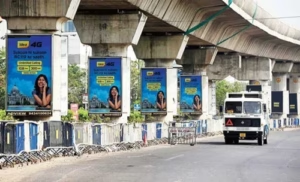
High Frequency Exposure
A single commuter traveling twice daily may see your brand 40 or more times per week. Over 30 days, that can exceed 150 exposures from the same individual.
Strategic Urban Placement
Metro pillars are positioned on arterial roads with continuous vehicular movement. That means consistent and uninterrupted line of sight branding.
Scalable Coverage
Brands can book single high impact pillars near junctions, clustered blocks for focused targeting, or full stretches for domination strategy.
24 by 7 Visibility
Unlike digital ads that depend on screen time, metro pillar branding works continuously day and night.
Cost Efficiency per Impression
When calculated against sustained daily exposure, cost per thousand impressions often becomes competitive compared to high frequency digital retargeting.
Benefits for Businesses
1. Trust Creation Through Physical Presence
Offline visibility increases perceived legitimacy. A brand visible in infrastructure linked spaces appears stable and established.
2. Memory Reinforcement
Consumers rarely buy the first time they see a brand. Metro pillar advertising ensures the brand stays in memory during consideration cycles.
3. Launch Acceleration
For new product launches or service announcements, repetitive pillar placements can create city wide awareness within weeks.
4. Local Market Penetration
For regional brands expanding in a city, metro corridors offer a practical entry strategy visible to daily commuters from multiple demographics.
5. Complement to Digital Campaigns
When users later see your digital ad, recognition triggers faster engagement. Offline repetition reduces digital acquisition friction.
Industries and Use Cases Where It Works Best
Metro Pillar Advertising performs strongly in industries where frequency influences buying behavior.
Real estate for project launches and site visits
Educational institutions during admission cycles
Hospitals and diagnostic centers
Retail chains and showrooms
Consumer durables
Fast moving consumer goods regional launches
Political awareness campaigns
Entertainment promotions including movie releases and serial launches
Urban services dependent on walk ins or location based trust benefit the most.
Where and When It Is Most Effective
Best Locations
Information technology corridors with dense office commuting
Commercial retail belts
Residential to office connecting routes
High signal traffic junction stretches
Best Timing
New brand entry into market
Festive season sales
Admission seasons
Real estate launch periods
Major product announcements
Metro pillar advertising works best when aligned with high intent periods.
Customization and Creative Options
Execution determines impact. Most brands fail not because the medium is weak but because creative execution is careless.
Options include:
Sequential storytelling across consecutive pillars
Bold typography with minimal copy
High contrast color palettes for distance visibility
Location based messaging such as directional cues
QR enabled extensions for digital tracking
Design must respect speed of viewing. Commuters do not read paragraphs. They register symbols, colors, and sharp headlines.
Why Choose Raagnaai Ads for Metro Pillar Advertising?
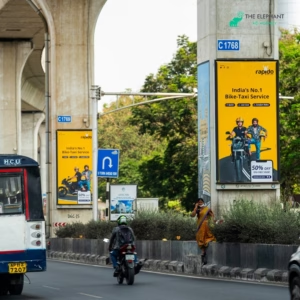
Execution errors destroy return on investment. Poor placement, cluttered designs, low visibility zones, or incorrect sizing reduce effectiveness.
A competent traditional marketing agency understands traffic flow psychology, viewing angles, speed based legibility, frequency mapping, budget to coverage optimization, and compliance requirements.
Raagnaai Ads focuses on strategic placement rather than random booking. The objective is not to fill pillars. The objective is to dominate attention along defined commuter routes.
Getting Started
Metro Pillar Advertising is not a decorative branding exercise. It is structured repetition engineered into daily urban movement. In cities where digital ads are skipped and attention is fragmented, physical repetition along commute routes remains one of the most underpriced influence tools.
If your brand is absent from major metro corridors, competitors are building recall in your place.
Visibility compounds. So does invisibility.