Most businesses think marketing is about running ads. It’s not. It’s about controlling attention in the real world.
If people don’t see your brand in their daily environment, they don’t register you as a serious player. This is not theory—this is how human perception works. People trust what they repeatedly see in physical spaces.
Digital ads are overcrowded, skipped, and forgotten. But outdoor visibility—especially in structured urban infrastructure like metro corridors—creates a completely different effect. It builds perceived scale, authority, and permanence.
Metro pillar advertising exists exactly for this reason. It’s not about “putting ads on pillars.” It’s about making your brand look like it belongs in the city itself.
What is Metro Pillar Advertising

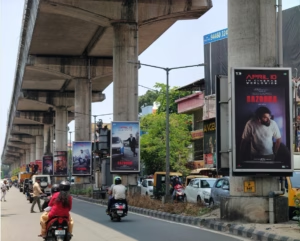
Metro pillar advertising is a form of outdoor branding where advertisements are placed on the vertical pillars supporting metro railway lines across major city roads.
These pillars are positioned along:
- High-traffic roads
- Business corridors
- Daily commute routes
Unlike hoardings, which people glance at occasionally, metro pillars are encountered continuously while moving. A commuter doesn’t see just one ad—they see your brand repeated across multiple pillars in a sequence.
This transforms advertising from a single exposure into a pattern of visibility, which is far more powerful in shaping memory and trust.
Purpose and Marketing Role
Metro pillar advertising serves a very specific role in a serious marketing system. It is not for short-term sales spikes. It is for long-term brand positioning.
First, it establishes geographic dominance. When your brand appears across a stretch of road, you are not just advertising—you are claiming that territory. Anyone commuting through that area starts associating your brand with that location.
Second, it creates perceived scale. People assume that brands visible across multiple public structures must be large, stable, and financially strong. Whether that’s true or not doesn’t matter—perception drives behavior.
Third, it ensures repetition without resistance. Unlike digital ads, which people actively avoid, outdoor ads are passively consumed. When the same brand appears again and again across pillars, the brain starts recognizing it without effort.
This is how real brand recall is built—not through one clever ad, but through consistent, unavoidable exposure.
Key Features of Metro Pillar Advertising
The strength of metro pillar advertising comes from how it combines placement, repetition, and structure.
The first key feature is high-frequency exposure. A person traveling along a metro corridor may see your brand 20–50 times within a few minutes. That level of repetition is difficult to achieve in any other medium at a comparable cost.
The second feature is strategic placement. Metro routes are not random—they are built through economically active zones. This means your ads are naturally placed where your potential customers already are: commuting to work, running businesses, or making purchasing decisions.
Another critical feature is visual dominance. These pillars are positioned at eye level for drivers, bikers, and pedestrians. Unlike elevated billboards that require attention, metro pillars sit directly in the viewer’s natural line of sight.
There is also the continuity factor. When multiple pillars carry the same branding, it creates a rhythm. This continuous exposure strengthens memory far more effectively than isolated advertisements.
Finally, metro pillar advertising offers scalable coverage. Brands can start with a few pillars or expand to dominate entire stretches of a city, depending on budget and strategy.
Benefits for Businesses
The biggest benefit is instant credibility. When people see your brand across metro infrastructure, they assume you are established. This matters more than most businesses realize. Customers often choose brands they perceive as “safe,” and visibility directly influences that perception.
Another major advantage is targeting the right economic segment. Metro corridors are heavily used by middle-class and upper-middle-class individuals—people with stable income and purchasing power. This makes the audience highly valuable for most industries.
Metro pillar advertising also creates local market control. If your brand dominates a specific route, competitors automatically look smaller in that geography. Even if they spend more elsewhere, you win in that zone because you are more visible.
It also builds strong recall without cognitive effort. People don’t consciously remember ads—they remember patterns. When your brand appears repeatedly in their daily commute, it becomes familiar. Familiarity leads to trust, and trust leads to preference.
Finally, it supports other marketing channels. If someone sees your brand offline and later encounters it online, the probability of engagement increases significantly. Metro pillar advertising acts as a reinforcement layer for your entire marketing system.
Industries and Use Cases Where It Works Best
This format is not universally effective. It works best for businesses where trust, visibility, and local presence directly influence buying decisions.
Real estate is one of the strongest use cases. Property buyers look for credibility, and large-scale outdoor presence signals stability and seriousness.
Educational institutions also benefit heavily. Parents and students are more likely to trust institutions they see consistently in public spaces.
Healthcare brands, including hospitals and clinics, gain from the trust factor. Visibility in structured infrastructure suggests reliability.
Retail chains, jewellery stores, and automobile showrooms also perform well because these industries depend on both brand recall and physical footfall.
In simple terms, if your business relies on people choosing you over competitors based on familiarity and trust, metro pillar advertising works.
Where and When It is Most Effective
Location selection is everything. Random placement reduces effectiveness significantly.
The best results come from:
- Metro routes near commercial hubs
- Roads connecting residential areas to office zones
- High-density traffic corridors
Timing also matters. This is not a short-term campaign tool. Running ads for a few weeks produces minimal impact.
Real results start when campaigns run for at least 2 to 3 months, allowing repeated exposure to build memory and trust.
It is especially effective during:
- New market entry
- Store launches
- Expansion phases
- High-competition periods
Customization and Creative Options
Most brands waste this opportunity because they treat it like a regular design exercise. That approach fails.
Creative execution must match how people actually consume these ads—while moving.
The most effective approach is extreme simplicity. One message, one visual, one brand. Anything more gets ignored.
Another powerful method is sequential storytelling. Instead of repeating the same design, different pillars can carry different parts of a message. This keeps the viewer engaged across the entire stretch.
Color choice is critical. High contrast and bold visuals work. Subtle designs do not. If your ad doesn’t stand out in less than two seconds, it fails.
Localized messaging also improves performance. Including regional language elements or area references increases relatability and trust.
Why Choose Our Agency
Outdoor advertising fails not because the medium is weak, but because execution is poor.
Most agencies sell space. They don’t think about strategy.
At Raagnaai Ads, the focus is on market impact, not just placement.
We approach metro pillar advertising as a system:
- Selecting routes based on audience movement
- Planning clusters for maximum dominance
- Designing creatives for real-world visibility, not aesthetics
- Ensuring consistent execution across all locations
The difference is simple: we don’t aim to “run ads.” We aim to make your brand unavoidable in specific markets.
Getting Started
Metro pillar advertising is one of the few channels that still delivers real-world authority.
It builds:
- Visibility that cannot be skipped
- Trust that cannot be faked
- Recall that compounds over time
In markets where competition is increasing and attention is fragmented, brands that win are the ones that control physical visibility.
This is not optional if you are serious about growth.