Modern marketing has a structural flaw that most businesses ignore. Visibility today is rented, not owned. The moment you stop paying for digital ads, your brand disappears from the customer’s view. This creates a cycle where businesses are forced to continuously invest just to maintain basic awareness, without ever building long-term recall.
For marketing managers and business owners, this becomes a serious inefficiency. Budgets increase, campaigns rotate, but brand memory remains weak. Customers don’t remember your brand because exposure is inconsistent. In highly competitive and price-sensitive markets, especially in India, this leads to one outcome—your brand becomes replaceable.
Wall Painting Advertising solves this problem at its core. Instead of chasing short-term impressions, it focuses on long-term visibility in fixed locations. It places your brand directly into the daily environment of your audience, where it is seen repeatedly over time. This repeated exposure builds familiarity, and familiarity is what drives trust and purchasing decisions in real-world markets.
What is Wall Painting Advertising
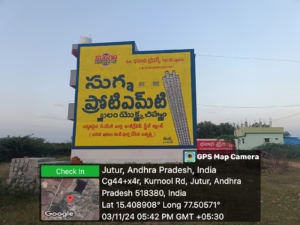
Wall Painting Advertising is a traditional outdoor marketing method where brand visuals, logos, taglines, and product messages are painted directly onto public-facing walls in high-visibility locations. Unlike temporary advertising formats such as hoardings or digital banners, wall paintings are semi-permanent installations designed to last for years.
This form of advertising is not dependent on platforms, algorithms, or recurring budgets. Once executed, it continues to deliver visibility every day without additional investment. The process involves identifying strategic locations, obtaining necessary permissions, designing creatives optimized for outdoor visibility, and executing the painting using durable, weather-resistant materials.
It can be customized into different formats such as low-rise wall paintings for street-level engagement, high-rise wall paintings for long-distance visibility, and digitally planned layouts for precision execution. The result is a consistent and unavoidable brand presence in a specific geographic area.
Purpose and Marketing Role
The primary purpose of wall painting advertising is to build long-term brand recall through repetition. Unlike performance marketing, which focuses on immediate actions like clicks or leads, wall painting is designed to influence memory over time.
In real-world buying behavior, especially in local markets, customers tend to choose brands they recognize. Recognition comes from repeated exposure. When a person sees the same brand multiple times in their daily routine, it becomes familiar. That familiarity creates trust, and trust significantly increases the likelihood of purchase.
Wall painting plays a strategic role in establishing this familiarity. It ensures that your brand is consistently visible in the same locations, reinforcing its presence in the minds of your audience. Over time, this creates a strong mental association between your brand and the product category you represent.
Key Features of Wall Painting Advertising
One of the defining features of wall painting advertising is its long-term visibility. A single execution can last anywhere between two to five years depending on the quality of materials and workmanship. This makes it fundamentally different from most advertising formats that require continuous renewal.
Another important feature is precise geographic targeting. Unlike digital ads that rely on data and algorithms to estimate audience relevance, wall painting allows you to place your brand exactly where your target customers are physically present. Whether it is near marketplaces, residential areas, highways, or retail zones, you have full control over placement.
Frequency of exposure is another major advantage. People who pass through the same routes daily will see your brand repeatedly without any additional cost. This repeated visibility is what builds strong recall over time. Unlike paid media, where increasing frequency requires higher budgets, wall painting delivers consistent frequency automatically.
Additionally, wall paintings are non-skippable. They exist in the physical environment, making them unavoidable. While digital ads compete for attention and are often ignored, wall paintings passively enter the viewer’s awareness and stay there through repetition.
Benefits for Businesses
Wall painting advertising offers one of the lowest long-term costs per impression among all marketing channels. Since it is a one-time investment with multi-year visibility, the effective cost decreases over time, making it highly efficient for sustained branding.
It also builds trust through familiarity. In many markets, customers associate repeated visibility with reliability. A brand that is consistently seen is perceived as established and credible, even if it is relatively new.
Another key benefit is competitive dominance. In many regions, businesses underutilize wall painting. This creates an opportunity for brands to occupy visual space and become the most recognized name in that area. When your brand is the most visible, it naturally becomes the preferred choice.
Wall painting also performs well in markets where digital penetration is limited or inconsistent. It ensures that your brand reaches audiences who may not be actively engaging with online platforms, thereby expanding your reach.
Industries and Use Cases Where It Works Best
Wall painting advertising is particularly effective in industries where local visibility directly impacts purchasing decisions. FMCG brands benefit from constant recall in daily consumption categories. Construction material companies such as cement and steel brands use wall painting to establish trust among dealers and end consumers.
Retail businesses and supermarkets leverage wall painting to drive footfall from nearby areas. Educational institutions and coaching centers use it to attract students within a specific radius. Healthcare providers, including clinics and pharmacies, benefit from local familiarity and trust-building.
It is also widely used in political campaigns and public awareness initiatives, where repeated exposure is essential to influence public perception.
Where and When It is Most Effective
The effectiveness of wall painting depends heavily on location selection. High-traffic areas such as busy roads, intersections, marketplaces, residential clusters, and transport routes provide maximum visibility. Walls that are positioned at eye level or along daily commute paths generate the highest frequency of exposure.
Timing also plays a strategic role. Wall painting is most effective during market expansion phases, product launches, dealer network development, and seasonal demand periods. It ensures that your brand is already familiar to customers when they are ready to make purchasing decisions.
Poor location selection significantly reduces effectiveness, regardless of design quality. Therefore, strategic placement is critical to achieving results.
Customization and Creative Options
Wall painting advertising offers flexibility in design and messaging. However, effectiveness depends on clarity rather than complexity. Since viewers often see wall paintings while moving, the message must be readable within a few seconds.
High-contrast colors, bold typography, and minimal text are essential for visibility. The brand name should be the most prominent element, followed by a simple and clear message. Visual elements can be used to enhance recall, but overdesigning reduces readability and weakens impact.
Customization can also include directional messaging, regional language adaptation, and design variations based on location type. The goal is to ensure that the message is instantly understood and easily remembered.
Why Choose Our Agency
Successful wall painting advertising requires more than execution. It demands strategic planning, location intelligence, and quality control. Many service providers focus only on painting, which leads to poor placement and weak results.
At Raagnaai Ads, the approach is based on understanding real-world movement patterns and visibility dynamics. Locations are selected based on traffic flow and audience relevance. Designs are created specifically for outdoor readability, ensuring that the message is clear even at a glance.
The execution process uses durable materials to ensure long-lasting visibility, minimizing the need for frequent maintenance. The focus is not just on completing the work, but on ensuring that it continues to deliver value over time.
Getting Started
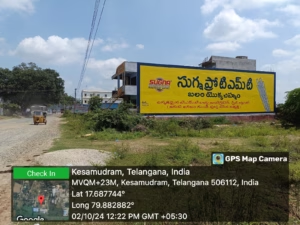
Wall Painting Advertising is often misunderstood as an outdated method, but in reality, it remains one of the most effective tools for building long-term brand recall. In a marketing environment dominated by short-term strategies, it offers a stable and cost-efficient way to maintain continuous visibility.
It works because it aligns with how people actually make decisions—through familiarity and repeated exposure. By placing your brand in the daily environment of your audience, it ensures that you remain top-of-mind when it matters most.
For businesses aiming to establish strong local presence and reduce dependency on ongoing advertising spend, wall painting provides a clear strategic advantage.